
If you’ve been shopping for insulation in Las Vegas, you’ve probably seen both spray foam and blown-in cellulose marketed as the best option for desert homes. They perform very differently when outdoor temps hit 115°F and your attic pushes well past 130°F.
Choosing the wrong material for the wrong location doesn’t just mean a slightly higher electric bill. It can mean rooms that never cool down, an HVAC system running nonstop, and energy bills that stay high well into October.
Neither insulation wins across the board. In our hot-dry climate, the smarter question isn’t which material is better, it’s where each one performs best in your home.
Not sure where to start? Schedule a free insulation evaluation and get a professional take before you decide.
What Makes Las Vegas Different (Climate Zone 3B)
Las Vegas and Clark County sit in IECC Climate Zone 3B, a hot-dry climate defined by its long, intense cooling seasons, very low humidity, and a heavy radiant heat load on roofs. That combination drives attic temperatures in Las Vegas homes far above outdoor air temps on summer afternoons, especially in vented attics, pushing heat downward through ceiling insulation and into the living space below. This is why heating and cooling account for the largest share of a typical home’s energy use.
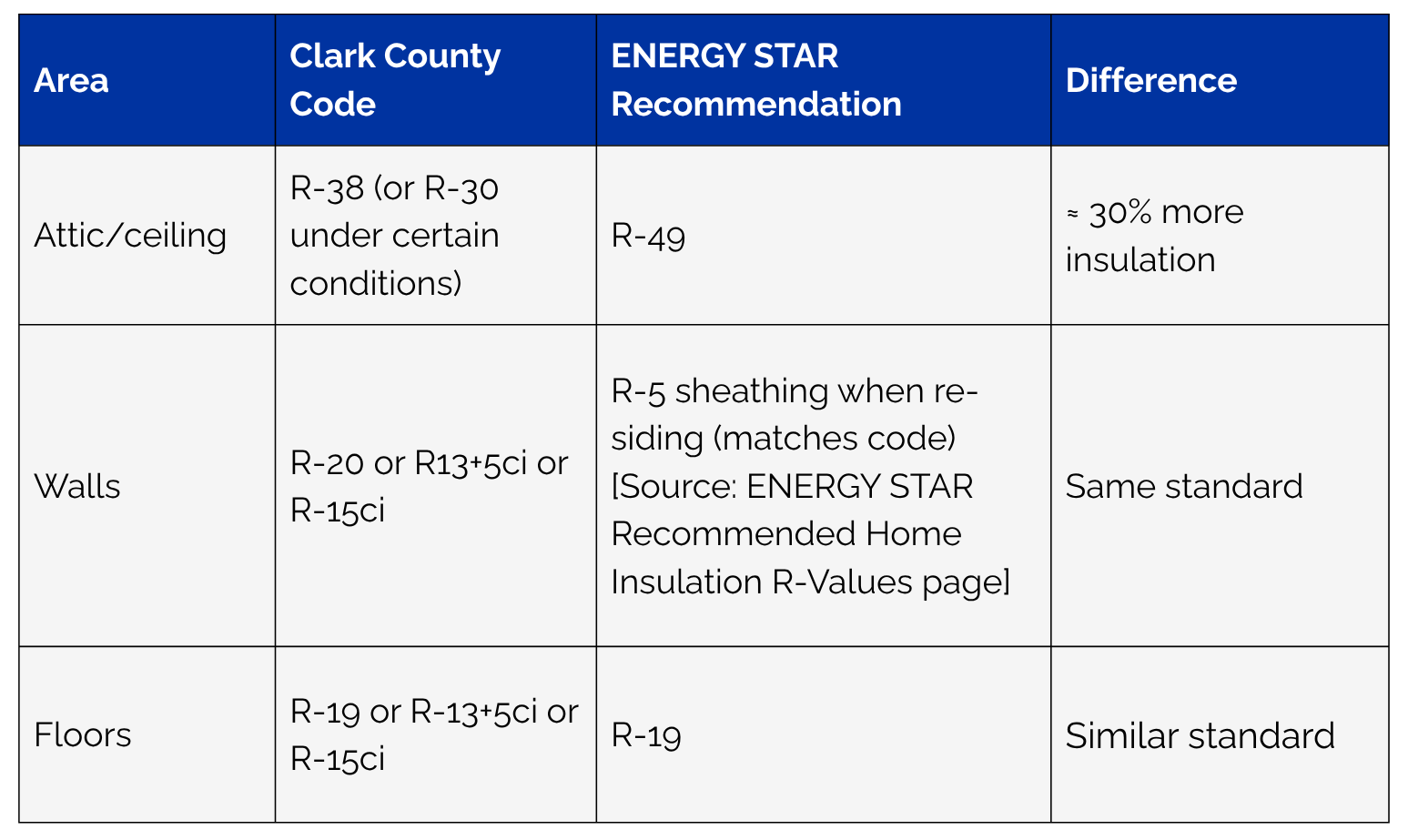
Nevada and Clark County’s attic R-value insulation requirements set the code minimum at R-38 for attics in zone 3B. That’s a floor, not a goal. ENERGY STAR recommends R-49 for Climate Zone 3 retrofits, which is significantly above the code minimum. For a deeper look at that gap, see “Why Las Vegas Building Code Insulation Minimums Aren’t Enough.” The choice between spray foam and cellulose is partly about how to beat that minimum cost-effectively, not just meet it.
Blown-In Cellulose — Strengths and Limits in the Desert
What It Is and Where It Wins in a Las Vegas Home
Blown-in cellulose Clark County installers use most often is made from 82%–85% recycled newsprint, treated with mineral borate for fire and insect resistance. On an insulation R-value per inch comparison, cellulose delivers roughly R-3.2 to R-3.8 per inch, putting it in the same range as loose-fill fiberglass but with better coverage in irregular spaces.
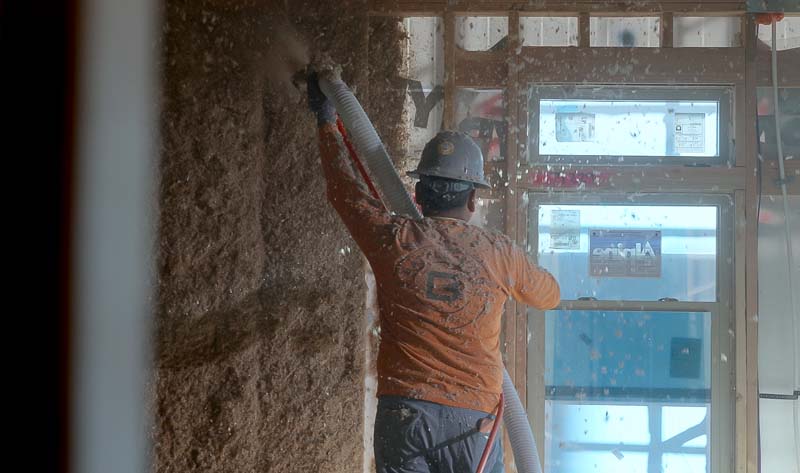
Cellulose insulation in Las Vegas performs best on attic floors in existing homes, where it can be blown to almost any depth to push R-value well above code at a low material cost in a vented attic. Dense-pack cellulose wall insulation is also a strong choice for existing wall retrofits. It’s injected through small holes from outside, restoring cavity R-value without removing drywall.
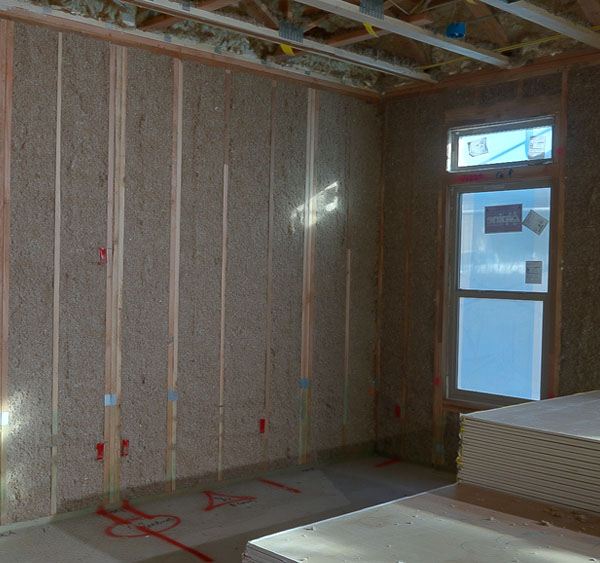
In new construction, dense-packed cellulose is installed along the underside of the roof deck to deliver high cavity R-value and support a conditioned attic approach without spray foam. Loose-fill cellulose also fills the small gaps around wiring, plumbing, and framing better than batts.
Where Cellulose Falls Short in 115°F Heat
Where cellulose falls short is air sealing. It’s not an air barrier. Hot air infiltrating through ceiling penetrations and recessed lights bypasses the insulation entirely. Cellulose on the attic floor also leaves HVAC equipment and ductwork found in most Las Vegas attics exposed to temperatures that can easily exceed 130°F in summer. This is a real efficiency penalty regardless of how thick the insulation layer is.
Spray Foam — Strengths and Limits in the Desert
What It Is and Where It Wins in a Las Vegas Home
Spray foam (polyurethane) is a liquid-applied insulation that expands and hardens on contact, conforming to the cavity and sealing penetrations in a single step. In Las Vegas’ dry climate, where humidity is not a problem, open-cell spray foam is the most widely used foam insulation. It is lightweight, delivers an R-value of approximately R-3.5 to R-3.7 per inch, and air seals and insulates in one step.
The biggest win for spray foam insulation in Las Vegas is roof deck application. Open-cell foam applied to the underside of the roof deck creates a conditioned attic Las Vegas homeowners with attic-mounted HVAC systems increasingly rely on. It moves the thermal boundary up and protects equipment from extreme summer attic temperatures. Moving the thermal boundary to the roofline with spray foam saves valuable energy compared to a vented attic. Without this raised thermal boundary, exposed HVAC ducts can increase energy use by 10% for heating and cooling.
Where Spray Foam is Not the Right Tool
Topping off an existing vented attic floor with spray foam is rarely cost-effective when depth is available and air sealing has already been handled separately. Cellulose gets to the same R-value for less material cost.
Frequently Asked Questions
The Right Material in the Right Place: Get a Free Evaluation
The “spray foam vs blown-in cellulose in Las Vegas” debate is the wrong frame. With attics that regularly hit 130°F+ and HVAC equipment often sitting in those same attics, the real question for Climate Zone 3B insulation in Nevada homes is where each material belongs and how the two work together.
Cellulose is the cost-effective workhorse for adding deep R-value to an open attic floor. Spray foam is the air-sealing specialist that earns its place in hard-to-reach cavities and at the roof deck when converting to a conditioned attic. Used in the right places, each material does what the other can’t.
Battle Born Specialties installs both blown-in cellulose and spray foam across the Las Vegas Valley. Our team gives you honest, location-by-location recommendations to provide the right insulation solution for your Nevada home. Schedule your free attic and insulation evaluation today, or call (702) 720-8839. (insert link to phone number) We’ll help you get through the next Las Vegas summer in comfort.
References:
ENERGY STAR. “Recommended Home Insulation R-Values.” U.S. Environmental Protection Agency, www.energystar.gov/saveathome/seal_insulate/identify-problems-you-want-fix/diy-checks-inspections/insulation-r-values.
ENERGY STAR. “Why Seal and Insulate?” U.S. Environmental Protection Agency, www.energystar.gov/saveathome/seal_insulate/why-seal-and-insulate.
Insulation Institute. “Nevada Energy Code: Summary of Key Residential Energy Code Requirements.” NAIMA, https://insulationinstitute.org/wp-content/uploads/2025/05/N129-NV-Energy-Code-0425.pdf.
Pacific Northwest National Laboratory. “Blown Insulation for Existing Vented Attic.” Building America Solution Center, U.S. Department of Energy, basc.pnnl.gov/resource-guides/blown-insulation-existing-vented-attic.
Pacific Northwest National Laboratory. “Find My Climate Zone.” Building America Solution Center, U.S. Department of Energy, basc.pnnl.gov/building-assemblies/climate-zone-lookup.
Pacific Northwest National Laboratory. “Unvented Conditioned Attic with Spray Foam Insulation Below Roof Deck.” Building America Solution Center, U.S. Department of Energy, basc.pnnl.gov/resource-guides/unvented-conditioned-attic-spray-foam-insulation-below-roof-deck.
U.S. Energy Information Administration. “Use of Energy Explained: Energy Use in Homes.” EIA, https://www.eia.gov/energyexplained/use-of-energy/homes.php.
Weiner, Cari. “Insulating Colorado Homes – 10.635.” Colorado State University Extension, extension.colostate.edu/topic-areas/family-home-consumer/insulating-colorado-homes-10-635/.
