
Many Las Vegas homeowners assume their homes meet modern energy efficiency standards because they were built to Clark County’s building code minimums. Las Vegas building code insulation minimums are based on IECC Climate Zone 3B standards that require R-38 in attics. However, these minimums represent the absolute floor of acceptable performance, not the standard for comfort or efficiency, and are well below what ENERGY STAR considers cost-effective.
That distinction matters more in Las Vegas than almost anywhere else. In a desert climate where summer attic temperatures can exceed 150°F, the gap between code minimums and recommended insulation levels directly impacts home energy efficiency in Las Vegas and homeowners’ experience. ENERGY STAR recommends attic insulation of R-49 for Climate Zone 3 — approximately 30% above the code minimum.
The U.S. Department of Energy notes that heating and cooling account for about 43% of a typical home’s energy costs, and under-insulated homes waste significantly more energy.
ENERGY STAR recommends R-49 for uninsulated attics, compared to Las Vegas’s IECC code requirement of R-38 (or as little as R-30 under special conditions). Upgrading to the recommended level can reduce heating and cooling costs by up to 15% and significantly improve home energy efficiency Las Vegas homeowners depend on during extreme temperatures.
Not sure if your insulation meets Clark County insulation requirements — or exceeds them? A free insulation evaluation can reveal exactly where your home is losing energy.
What Clark County’s Code Actually Requires
Clark County’s residential energy code is based on the 2024 IECC, and the Nevada Governor’s Office of Energy is required by NRS 701.220 to adopt the most recently published IECC on a triennial basis.
Under the prescriptive path for IECC climate zone 3B, the code requires approximately:
- R-38 for ceilings/attics, or R-30 under specific conditions
- R-20 or R-13+5ci or R-0+15ci (ci= continuous insulation) for wood-frame walls
- R-19 or R-13+5ci or R-15ci for floors above unconditioned spaces
- R-0 for unheated slabs
These Clark County insulation requirements define the minimum standard for construction, not optimal performance.
The U.S. Department of Energy confirms that insulation requirements vary by climate and application, reinforcing why Las Vegas homes often need to exceed the minimum code.
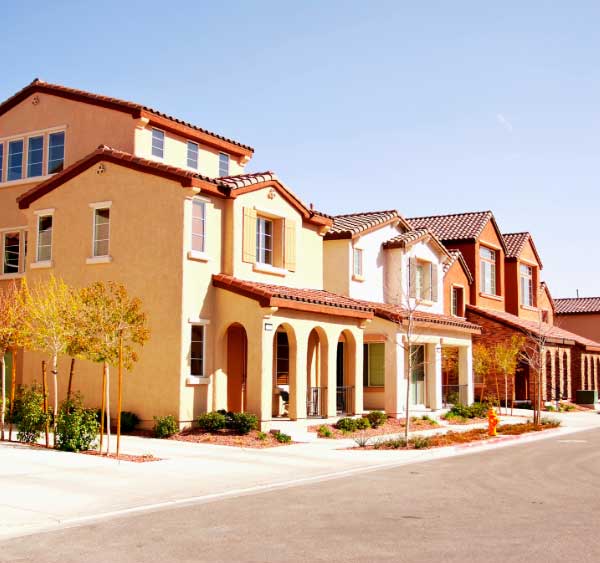
What “Minimum” Really Means
Las Vegas building code insulation minimums are the legal baseline — the lowest-performing insulation a builder can install and still pass inspection.
They are not designed to:
- Optimize home energy efficiency Las Vegas homes need
- Minimize energy bills
- Handle extreme desert heat
Clark County’s 2024 IECC adoption (fully adopted January 11, 2026) includes Southern Nevada-specific amendments, but the core residential insulation R-values for Climate Zone 3B attics remain modest relative to federal efficiency recommendations. Effective dates vary slightly by jurisdiction in the valley. Homes inside City of Las Vegas limits fall under a January 5, 2026 effective date, so confirm which jurisdiction governs your address.
What ENERGY STAR and the DOE Actually Recommend
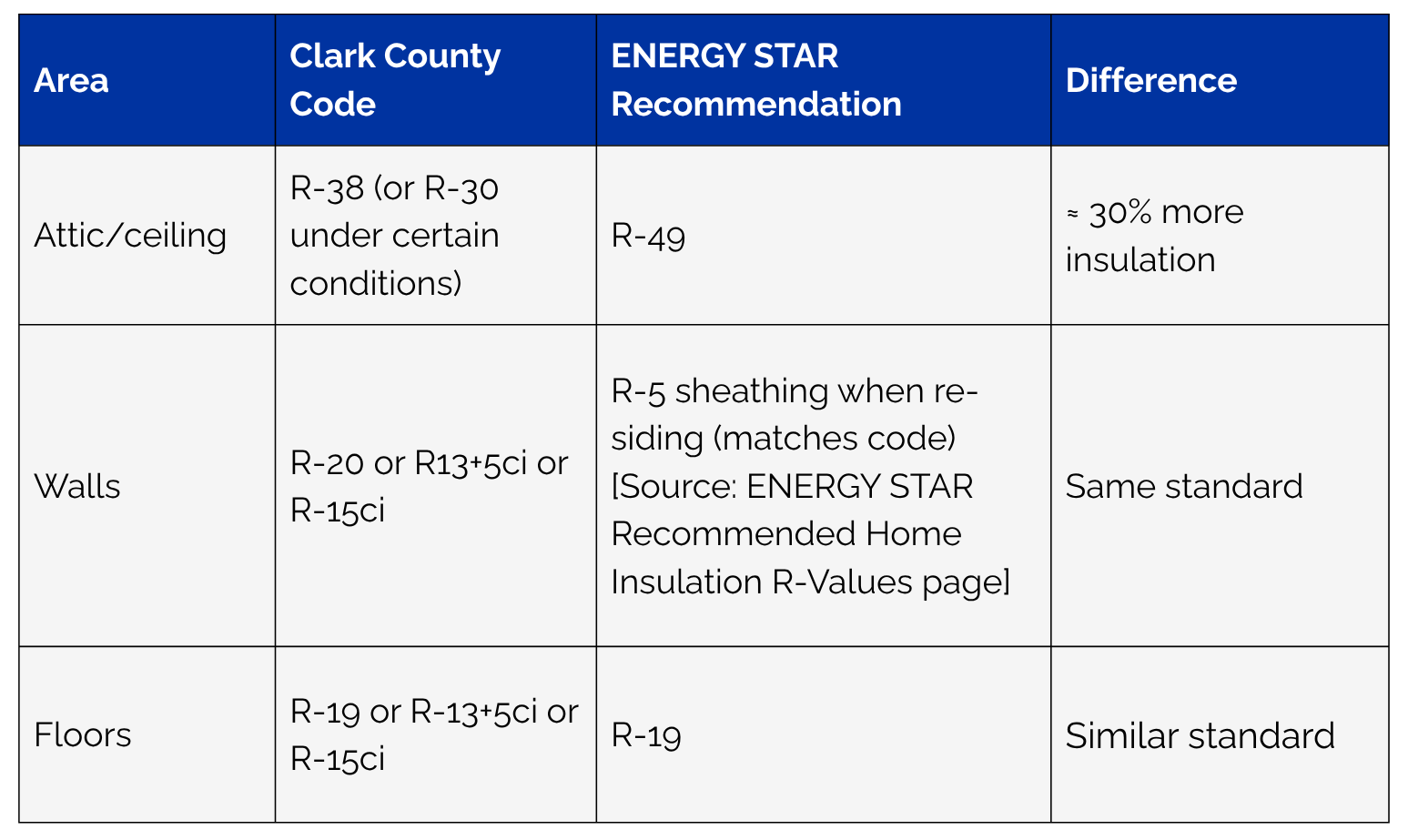
The R-Value Gap, Area by Area
ENERGY STAR insulation recommendations for Climate Zone 3 include:
- Attic insulation R-49 (uninsulated attics)
- R-38 for attics with existing insulation
- R-19 for uninsulated floors
- For walls, ENERGY STAR suggests adding R-5 insulative sheathing when siding is replaced, which aligns with the Clark County wall requirement (R-20 or R-13+5ci or R-0+R15ci), so there is no meaningful gap.
Why the Gap Matters in Las Vegas
With heating and cooling accounting for a large share of a home’s energy use, properly insulating and air sealing reduces both energy costs and your carbon footprint. This makes insulation a key driver of home energy efficiency Las Vegas homeowners experience.
ENERGY STAR reports that homeowners can save an average of 15% on heating and cooling costs by air sealing and adding insulation in attics, floors, and basements.
In a desert climate with around 80 days above 100°F in a typical year, that 15% savings compounds dramatically over a cooling season that runs May through October.
Which Upgrades Deliver the Best Return
Priority 1: Attic Insulation
The attic is the single highest-impact upgrade for Las Vegas homes because heat radiates down from superheated roof decks all summer.
Upgrading from R-38 to R-49 using blown-in cellulose or fiberglass is the most cost-effective first step. ENERGY STAR agrees that insulating and air sealing the attic with appropriate insulation tailored to climate, home size, and condition is one of the most important steps homeowners can take towards a more comfortable and energy-efficient home.
This upgrade:
- Reduces heat transfer
- Improves comfort
- Lowers cooling costs
This is typically the most cost-effective insulation upgrade Las Vegas homeowners can make.
Priority 2: Air Sealing + Wall Insulation
Even high insulation levels can underperform without proper air sealing. Air sealing is critical alongside insulation, as gaps around penetrations, outlets, and top plates can undermine even high-R insulation.
The DOE emphasizes that insulating your home not only reduces energy costs but also improves comfort, and that air sealing should accompany any insulation upgrade for best results.
Upgrades include:
- Improved wall insulation R-values
- Adding continuous insulation
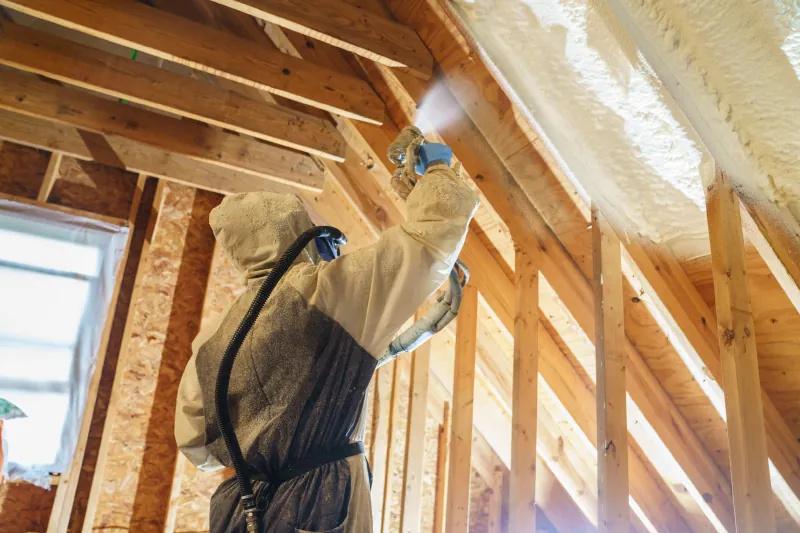
- Using spray foam insulation for combined air sealing and insulation
Priority 3: Floors and Foundations
Many Las Vegas homes are unheated slab-on-grade, for which local Clark County code requires R-0 insulation (no floor insulation at all). ENERGY STAR does not list recommendations for unheated slabs. However, for homes with raised floors, Clark County’s IECC Code requires R-19 or R-13+5ci or R-15ci insulation, while ENERGY STAR recommends R-19.
Upgrading floors improves:
- Comfort
- Temperature consistency
- Overall home energy efficiency Las Vegas residents benefit from
Frequently Asked Questions
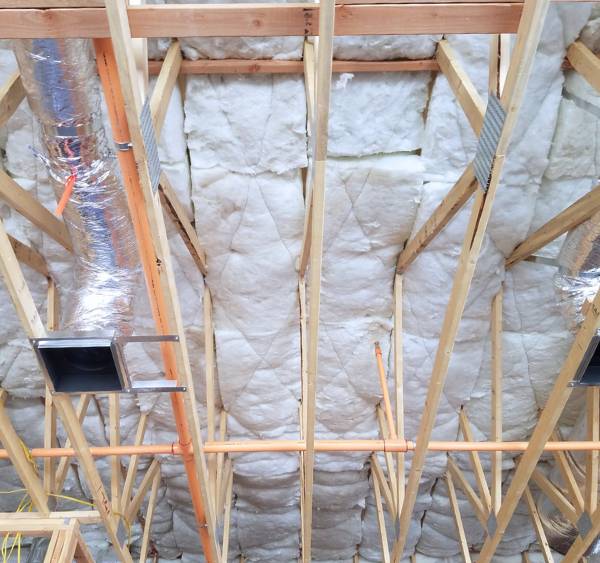
Las Vegas building code insulation minimums are just the baseline. Las Vegas homeowners who insulate beyond code minimums enjoy lower energy bills, improved comfort, and better long-term home value. The biggest opportunity is in the attic: upgrading from R-30 to R-49 is the single most impactful insulation improvement for most Las Vegas homes.
Contact Battle Born Specialties today for a free insulation evaluation. Our experienced team installs beyond code minimums so Las Vegas homeowners get real comfort and real savings — not just a passing inspection. Call (702) 720-8839 or contact us now to get started.
References:
Arizona State University Energy Efficiency Center. “Energy Savings by Insulation.” ASU Energy Efficiency Center, 11 July 2023, eec.asu.edu/2023/07/11/energy-savings-by-insulation/.
Clark County, Nevada. “Building and Fire Prevention: Codes.” Clark County Building Department, www.clarkcountynv.gov/government/departments/building___fire_prevention/codes/.
ENERGY STAR. “Methodology for Estimated Energy Savings from Sealing and Insulating.” U.S. Environmental Protection Agency, www.energystar.gov/saveathome/seal_insulate/methodology.
ENERGY STAR. “Recommended Home Insulation R–Values.” U.S. Environmental Protection Agency, www.energystar.gov/saveathome/seal_insulate/identify-problems-you-want-fix/diy-checks-inspections/insulation-r-values.
ENERGY STAR. “Why Seal and Insulate?” U.S. Environmental Protection Agency, https://www.energystar.gov/saveathome/seal_insulate/why-seal-and-insulate.
Internal Revenue Service. “Energy Efficient Home Improvement Credit.” www.irs.gov/credits-deductions/energy-efficient-home-improvement-credit.
Nevada Governor’s Office of Energy. “Building Energy Codes.” State of Nevada, www.energy.nv.gov/programs/building-energy-codes/.
Pacific Northwest National Laboratory. “Find My Climate Zone.” Building America Solution Center, U.S. Department of Energy, basc.pnnl.gov/building-assemblies/climate-zone-lookup.
University of Nevada, Reno Extension. “Climate Change Impacts in Nevada.” Cooperative Extension, 2021, extension.unr.edu/publication.aspx?PubID=3957.
UpCodes. “Clark County Energy Code 2024.” https://up.codes/viewer/clark-nevada/s-nv-energy-conservation-code-2024/chapter/RE_4/re-residential-energy-efficiency#R402.1.3.
U.S. Energy Information Administration. “Use of Energy Explained: Energy Use in Homes.” EIA, www.eia.gov/energyexplained/use-of-energy/homes.php.
